


About This Coffee
Most Indian Arabica tells a familiar story: clean, structured, chocolate and caramel notes from washed lots grown in Coorg and Chikmagalur. This experimental lot from Sandalkad Estate is a farm-level innovation, small-batch processed and developed through a herb fermentation method unique to this single-estate farm.
Hand-picked cherries ferment with herbs sourced from the estate’s own land in a sealed, low-oxygen environment. Shade drying follows, a slow, deliberate process that preserves aromatic complexity and performs beautifully across light to medium roast levels.
If you have never roasted an Indian coffee before, this is where to start. Sandalkad Estate is a multi-generational, family-farmed operation, in the same hands for six generations, more than 170 years, farmed with soil-conserving, no-till practices that keep this rainforest-adjacent land productive without depleting it. This lot is fully traceable, grower-to-roaster, to a single farm-identified block.
Where Does It Come From?
- Country: India
- Region: Kodagu (Coorg), Karnataka
- Estate: Sandalkad Estate
- Altitude: 1,100 – 1,300 MASL
- Variety: Arabica (Mixed)
- Grade: Specialty
- Lot Type: Experimental, Limited Release, Estate-Exclusive
- Process: Herb Fermented, Shade Dried
- Drying: Raised Bed
- Farming: Agroforestry, Shade Grown (Two-tier Canopy), Rainforest-Adjacent
- SCA Score: 86.5 points
Kodagu, known widely as Coorg, sits within Karnataka’s share of the Western Ghats, a mountain range whose elevation, rainfall, and old-growth, rainforest-adjacent forest cover have made it one of Asia’s most established coffee growing districts. Sandalkad Estate’s Arabica grows on high-canopy blocks between 1,100 and 1,300 metres, intercropped with pepper and cardamom under a native shade canopy and two-tier canopy system.
Sandalkad Estate has been farmed by the same family for six generations, since 1850, under the stewardship of the Siddiqua family, a long-term producer relationship built through years of producer development and direct sourcing. Soil-conserving, minimal-disturbance farming keeps the estate’s old-growth shade trees and understory intact season after season. Sandalkad Estate takes its name from the sandalwood forest on which it grows.
This lot is a genuinely experimental, limited-release natural process, a post-harvest innovation farm-identified to this estate alone. Hand-picked cherries ferment with herbs sourced from the estate’s own land before drying on raised beds, small-batch and traceable green coffee from a single origin block.
Flavour Potential
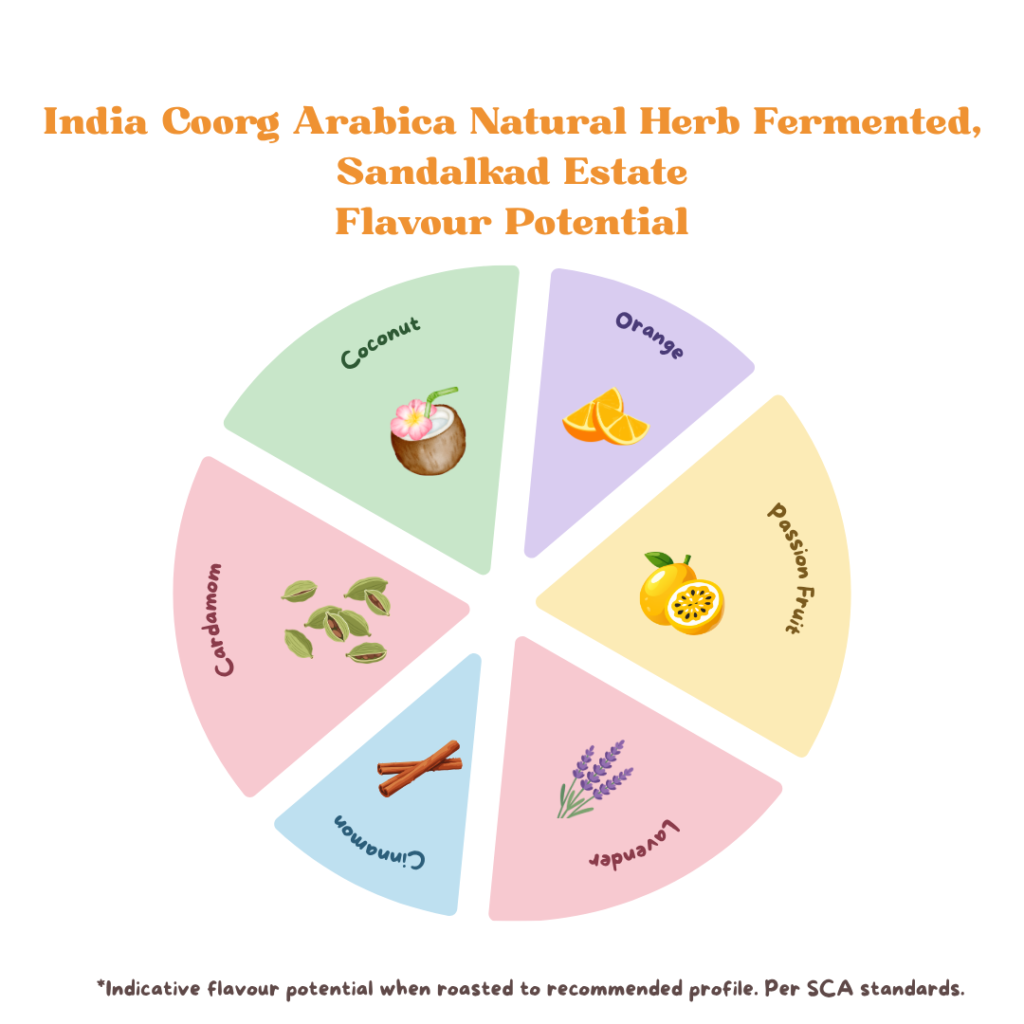
India Coorg Arabica Natural Herb Fermented, Sandalkad Estate delivers one of the most complex and layered cup profiles in Indian specialty coffee. Across light to medium roast levels, home roasters can expect to unlock:
- 🌿 Cardamom – aromatic, spiced, upfront
- 🥥 Coconut – creamy, round, milk-like sweetness
- 🍈 Passion Fruit – tropical brightness through the mid palate
- 🪻 Lavender – floral, fragrant, elegant
- 🍊 Orange – clean citrus lift in the finish
- 🍂 Cinnamon – warm spice, lingering in the aftertaste
Flavour potential is indicative only. Final cup profile depends on roast level and brewing method. Per SCA cupping standards.
The herb fermentation process is responsible for the spice and floral complexity that defines this coffee. Fermenting the whole cherry in a sealed, low-oxygen environment alongside estate-grown herbs allows aromatic compounds to transfer into the bean through the cherry skin, building a profile that no standard natural or washed process can replicate. Shade drying preserves what the fermentation builds, slowly, without the aromatic flattening that fast direct-sun drying causes.
What Is Herb Fermented Natural Processing?
If you are new to green coffee, understanding this processing method will help you understand why India Coorg Arabica Natural Herb Fermented, Sandalkad Estate tastes the way it does.
Herb Fermented Natural Process means:
- Cherries are handpicked selectively at peak ripeness
- Whole cherries, skin, pulp, and mucilage intact, are placed in sealed, low-oxygen fermentation vessels
- Herbs sourced directly from the estate’s own land are introduced alongside the cherries inside the vessel
- Fermentation takes place in a controlled environment, allowing herb compounds to transfer into the bean through the cherry skin
- After fermentation, cherries are dried under shade rather than direct sun
- Shade drying is a slow, deliberate process that preserves aromatic complexity and prevents the flattening that fast drying causes
- Full cherry contact throughout both fermentation and drying builds dense sweetness and layered herbal aromatic character
Why this processing matters for home roasters:
- Produces a complex, layered aromatic profile unlike any standard natural or washed process
- Spice, floral, and tropical fruit notes are built into the bean before roasting begins
- Shade drying gives the coffee exceptional structure and consistency across roast levels
- Performs across light, filter, and medium roast profiles, not locked into a single narrow window
- One of the most distinctive and conversation-worthy coffees you can put in your roaster
Roast Recommendation
Recommended Roast Range: Light to Medium
India Coorg Arabica Natural Herb Fermented, Sandalkad Estate is one of the most roast-flexible Indian green coffees available. The herb fermentation and shade drying give this coffee exceptional structure that holds up across a genuine range of roast levels, each one expressing a different facet of the fermentation’s complexity.
Roast guide:
- Roast Level: Light to Medium
- Target Drop Temperature: 195°C – 215°C
- First Crack: Drop shortly after first crack begins to develop
- Development Time: 60 – 90 seconds after first crack
- Colour: Light to medium brown, no surface oil
Tips for home roasters:
- A light roast preserves the most vivid herbal and floral character, coconut, orange, and lavender lead the cup with vibrant acidity and delicate sweetness
- A light to medium roast softens the acidity and rounds the mouthfeel while keeping coconut and tropical fruit brightness intact
- A medium roast shifts the profile toward plum, mixed berries, and cacao nibs with a sweet caramel finish, a rounder, more familiar expression of the same coffee
- Avoid roasting beyond Full City, you will lose the floral and spice complexity that makes this coffee exceptional
- Rest 5 – 7 days after roasting before your first brew for best results
- This coffee rewards careful note-taking, the difference between roast levels is significant and worth exploring
Brewing Suggestion
Once roasted, India Coorg Arabica Natural Herb Fermented, Sandalkad Estate is best showcased through brewing methods that allow its aromatic complexity and floral clarity to express fully. Clean, filter-focused methods bring out the best this coffee has to offer.
Recommended brewing methods:
- ☕ Pour Over – the ideal method; floral, spiced, aromatic and clean
- ☕ Filter / Drip – balanced, approachable, highlights the sweetness and spice
- ☕ Aeropress – concentrated, complex, outstanding at light roast
- ☕ French Press – full bodied, rounds out the tropical fruit character
- ☕ Espresso – works beautifully at medium roast, rich and spiced with natural sweetness
Brewing tips:
- Water temperature: 90°C – 94°C
- Grind: Medium-fine for pour over, medium for filter, fine for espresso
- Ratio: 1:15 to 1:16 coffee to water for filter brewing
- Allow 5 – 7 days rest after roasting before brewing for best results
- Brew black – this coffee’s aromatic complexity is best experienced without milk
Is This Coffee Right For Me?
Yes, if you are:
- A home roaster looking for something genuinely different from your usual Colombian or Ethiopian
- Someone curious about Indian specialty coffee and where to start
- A roaster who enjoys floral, spiced, and tropical fruit-forward cup profiles
- Someone who wants a coffee with a real processing story and provenance behind it
- An experienced roaster looking for a distinctive, conversation-worthy single origin
Consider another origin, if you prefer:
- A community lot with bright, citrus-forward sweetness, try our India B.R. Hills Arabica Honey Process
- A three-varietal blend with earthy, spiced depth, try our India Palani Hills Arabica Washed
How To Store Your Green Coffee Beans
Green coffee beans are incredibly stable when stored correctly, far more so than roasted coffee.
Storage tips:
- Store in a cool, dry place away from direct sunlight
- A cupboard or pantry at room temperature is ideal
- Do not refrigerate or freeze
- Allow the beans to breathe, avoid fully airtight containers
- Use a paper bag or a container with a loose fitting lid
- Stored correctly, green coffee beans remain fresh for up to 12 months
Why Buy From Roasters Hall?
Every coffee on Roasters Hall is chosen and shipped with Canadian home roasters in mind.
- Specialty grade only – every coffee we carry is SCA specialty grade 84 points and above
- Small retail packs – 200g, 350g, 500g and 1kg, perfect for home roasters
- Small-batch, producer-direct – limited quantities sourced directly from the farm to ensure freshness
- Ships across Canada – coast to coast, fast and reliable
- Farm-to-cup traceability – origin-to-roaster records on every lot we carry
- Home roaster focused – built for the Canadian home roasting community
Frequently Asked Questions
What is India Coorg Arabica Natural Herb Fermented, Sandalkad Estate green coffee?
India Coorg Arabica Natural Herb Fermented, Sandalkad Estate is an experimental herb fermented natural process specialty green coffee from Sandalkad Estate in Kodagu (Coorg), Karnataka, India. Grown at 1,100 – 1,300 metres and scored 86.5 on independent cupping evaluation, it is one of the most distinctive Indian specialty green coffees available to Canadian home roasters, spice-forward, fruit-accented, and unlike any standard washed Indian Arabica.
What does herb fermented natural process mean?
Herb fermented natural process means the whole coffee cherry, skin, pulp, and mucilage intact, is fermented in a sealed, low-oxygen environment alongside herbs sourced from the estate’s own land. Herb compounds transfer into the bean through the cherry skin during fermentation, building the spice and floral aromatic complexity this coffee is known for. Shade drying follows to preserve everything the fermentation builds.
What roast level is best for India Coorg Arabica Natural Herb Fermented, Sandalkad Estate?
India Coorg Arabica Natural Herb Fermented, Sandalkad Estate performs across a genuine range of roast levels. A light roast preserves the most vivid herbal, floral, and tropical fruit character, coconut, lavender, and orange lead the cup. A medium roast shifts toward plum, mixed berries, and cacao nibs with a sweet caramel finish. Every roast level reveals a different and equally valid expression of this coffee.
Is India Coorg Arabica Natural Herb Fermented, Sandalkad Estate good for beginner home roasters?
Yes, though it rewards careful attention. The herb fermentation gives this coffee exceptional structure that holds up across roast levels, making it more forgiving than most natural process coffees. Beginners will find it approachable at a light to medium roast. The distinctive flavour profile also makes it an exciting and educational coffee to roast and taste.
How does India Coorg Arabica Natural Herb Fermented, Sandalkad Estate compare to Ethiopia Yirgacheffe?
Both are natural process coffees with complex aromatic profiles but they express very differently. Ethiopia Yirgacheffe delivers intense blueberry, jasmine, and bergamot character from a traditional natural process. India Coorg Arabica Natural Herb Fermented, Sandalkad Estate delivers cardamom, coconut, and tropical fruit from a proprietary herb fermentation unique to Sandalkad Estate. Yirgacheffe is fruit-forward and floral. India Coorg Arabica Natural Herb Fermented, Sandalkad Estate is spiced, creamy, and distinctly Indian.
Do you ship green coffee beans across Canada?
Yes. Roasters Hall ships specialty green coffee beans to all provinces across Canada. Orders are packed fresh and dispatched within 1 – 2 business days.
What makes Indian specialty coffee different?
Indian specialty coffee is grown at elevation in the Western Ghats under native forest shade canopy, intercropped with spices including pepper, cardamom, and vanilla. This agroforestry environment builds density, sweetness, and aromatic complexity in the green bean. Indian Arabica at its best offers cup profiles that are genuinely distinct from African or Latin American origins, spiced, structured, and layered in ways that reward careful roasting.
How long do green coffee beans last?
When stored correctly in a cool, dry place away from direct sunlight, green coffee beans remain fresh for up to 12 months. Green beans are significantly more stable than roasted coffee, which begins to go stale within weeks of roasting.


Reviews
There are no reviews yet.