


About This Coffee
Most Ethiopian naturals available to home roasters vary in consistency, since natural processing introduces more variables than washed. This lot is different: a genuine Grade 1 classification, Ethiopia’s highest, permitting virtually no defects across sample cupping.
This is a community lot, grown by 1,700 smallholder farmers who deliver ripe cherry to a shared processing station, where cherries are selectively hand-picked and spread across raised drying beds. The traditional Ethiopian garden coffee model means coffee grows intercropped alongside food crops and shade vegetation, rather than as an isolated monocrop.
Grown from 74110 and 74112, both established Ethiopian varieties, this lot reflects the genuine complexity Yirgacheffe naturals are known for: blueberry and jasmine upfront, stone fruit through the body, brown sugar sweetness carrying into a long, floral finish. Farm-level innovation and careful post-harvest management are what separate a lot like this from typical commercial-grade naturals.
Where Does It Come From?
- Country: Ethiopia
- Region: Yirgacheffe, Gediyo Zone
- Farm: Community Lot, 1,700 Smallholder Farmers
- Altitude: 1,999 – 2,050 MASL (farms) / 2,223 MASL (processing station)
- Variety: 74110, 74112 (100% Arabica)
- Grade: Grade 1
- Lot Type: Community Lot
- Process: Natural, Sun-Dried
- Drying: Raised Bed
- Farming: Intercropped/Polyculture
Yirgacheffe sits within Ethiopia’s Gediyo Zone, in the southern highlands, an area whose elevation and volcanic soils have long made it one of the country’s most recognized coffee-growing districts. This community lot grows between 1,999 and 2,050 metres, among the highest-altitude Yirgacheffe farms currently available in the Canadian market, with the processing station itself sitting at 2,223 metres.
Cherries are grown by 1,700 smallholder farmers in traditional backyard garden plots, intercropped with food crops and shade vegetation, a model where coffee grows alongside the rest of a family’s land rather than as a separate cash crop. Harvest begins in December, when cherries reach full maturity, and are selectively hand-picked before delivery to a shared processing station.
There, cherries are spread across 180 raised drying beds over a 2.5-hectare site, drying slowly and evenly under natural sun. Achieving Grade 1 classification on a natural-process lot is genuinely difficult, since natural processing introduces more variables than washed coffee, requiring careful, well-managed drying to maintain clean, consistent cup quality across a community-sourced harvest of this scale.
Flavour Potential
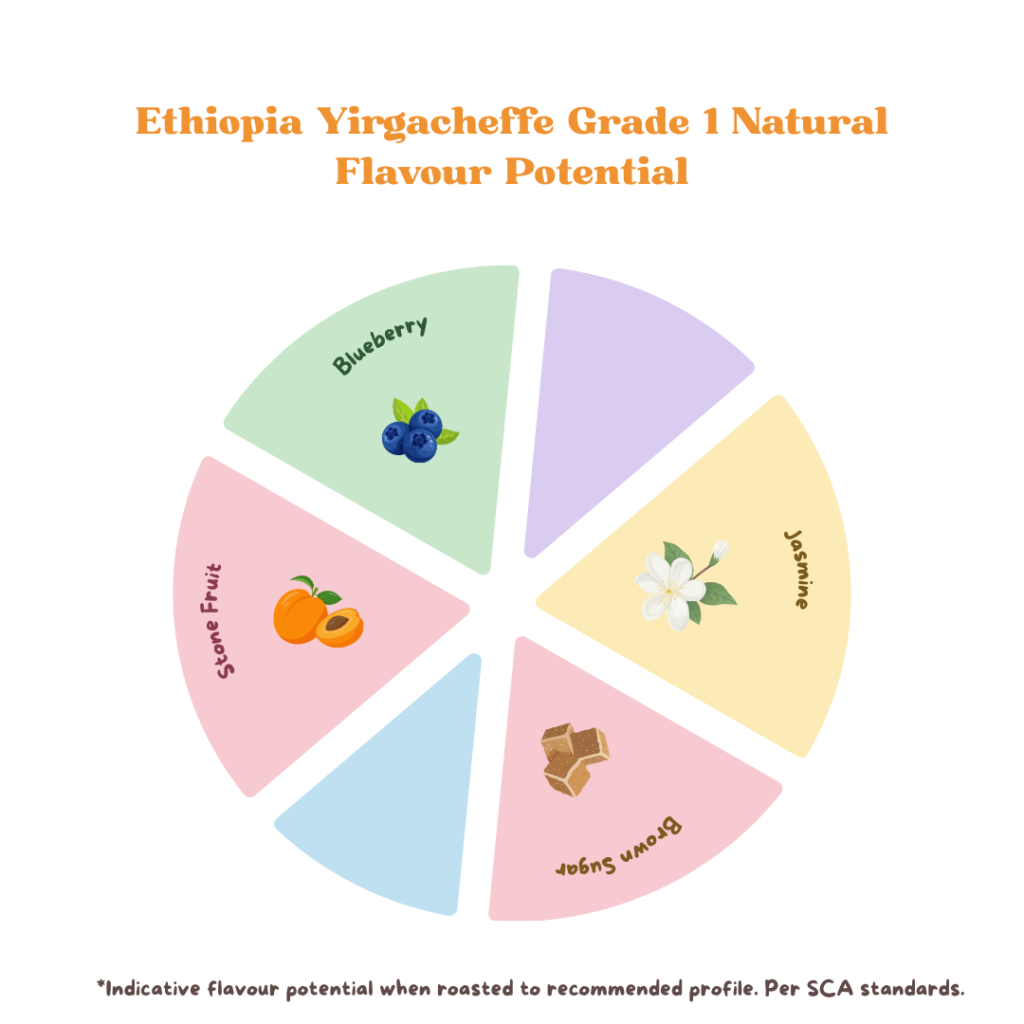
Ethiopia Yirgacheffe Grade 1 Natural delivers a genuinely complex, fruit-forward cup profile. At light to medium roast, expect to unlock:
🫐 Blueberry – bright, jammy, upfront
🌸 Jasmine – floral, fragrant
🍑 Stone Fruit – juicy, layered through the body
🍯 Brown Sugar – warm sweetness carrying through the finish
Flavour potential is indicative only. Final cup profile depends on roast level and brewing method. Per SCA cupping standards.
Acidity stays balanced, fruit-driven and clean, never sharp. Body is medium, smooth and silky rather than heavy, with a long, sweet finish where floral character lingers well after the last sip.
What Is Natural Processing?
If you are new to green coffee, this processing method explains why Ethiopia Yirgacheffe Grade 1 Natural tastes the way it does.
Natural, Sun-Dried means:
- Ripe cherries are selectively hand-picked at peak maturity
- Whole cherries dry intact in the sun, rather than having the skin and fruit removed first
- Cherries are spread across raised drying beds, allowing even airflow and preventing ground contact
- As the cherry dries, sugars and fruit compounds are absorbed into the bean, building sweetness and fruit character
Why this matters for home roasters:
- Produces a fruit-forward cup that washed processing cannot replicate
- Introduces more variability than washed coffee, so achieving Grade 1 consistency reflects genuinely careful production
- Builds pronounced blueberry, jasmine, and stone fruit character
- Best suited to lighter roast levels, where this complexity is most fully expressed
Roast Recommendation
Recommended Roast Range: Light to Medium
At 1,120 g/L, this is an exceptionally dense green coffee, among the densest in the Ethiopian range. High density means more heat energy and longer time to first crack, so a moderate charge temperature and slow, thorough drying phase gives the Maillard phase adequate time before first crack approaches.
Roast guide:
- Roast Level: Light to Medium
- Target Drop Temperature: 195°C – 210°C
- First Crack: Drop at first crack for light roast; drop 45 seconds after first crack begins for medium
- Colour: Light to medium brown
Tips for home roasters:
- Light roast: blueberry and jasmine peak in intensity, stone fruit sweetness emerges as the cup cools, best for pour over and Chemex
- Medium roast: fruit deepens toward berry and stone fruit, jasmine softens into warm floral sweetness, brown sugar finish becomes richer, excellent for filter and single origin espresso
- Medium-dark roast: dark chocolate and caramelized sweetness take over, fruit character recedes into the background
- Dark roast is not recommended for this lot: the exceptional quality and complexity this Grade 1 classification earns is largely lost beyond medium-dark development
- Rest 5 – 7 days after roasting before brewing for best results
Brewing Suggestion
Once roasted, Ethiopia Yirgacheffe Grade 1 Natural is best showcased through brewing methods that let its floral and fruit complexity express fully.
Recommended brewing methods:
☕ Pour Over – ideal, brings out blueberry and jasmine clarity most precisely
☕ Chemex – clean, bright, highlights the floral finish
☕ Filter/Drip – balanced, approachable, fruit and brown sugar sweetness come through clearly
☕ Espresso – excellent at medium roast, single origin
Brewing tips:
- Water temperature: 90°C – 94°C
- Grind medium-fine for pour over, medium for filter, fine for espresso
- Allow 5 – 7 days rest after roasting before brewing
- Brew black to experience the full floral and fruit complexity
Is This Coffee Right For Me?
Yes, if you are:
- A home roaster who wants a genuinely complex, fruit-forward natural process coffee
- Someone who enjoys bright, floral cups with blueberry and stone fruit character
- Interested in supporting a community-sourced lot from 1,700 smallholder farmers
- Curious about one of Ethiopia’s highest export classifications
Consider another origin, if you prefer:
- A clean, balanced everyday coffee, try our Colombia Huila Supremo Washed
- A savory, spice-forward washed Robusta, try our India Coorg Robusta Washed AA, Pambukal Estate
How To Store Your Green Coffee Beans
Green coffee beans are incredibly stable when stored correctly, far more so than roasted coffee.
- Store in a cool, dry place away from direct sunlight
- A cupboard or pantry at room temperature is ideal
- Do not refrigerate or freeze
- Allow the beans to breathe, avoid fully airtight containers
- Stored correctly, green coffee remains fresh for up to 12 months
Why Buy From Roasters Hall?
Every coffee on Roasters Hall is chosen and shipped with Canadian home roasters in mind.
- Specialty grade only – every coffee we carry is SCA specialty grade 84 points and above
- Small retail packs – 200g, 350g, 500g and 1kg, perfect for home roasters
- Direct-sourced – small quantities sourced to ensure freshness
- Ships across Canada – coast to coast, fast and reliable
- Farm-to-cup traceability – we tell you exactly where your coffee comes from
- Home roaster focused – built for the Canadian home roasting community
Frequently Asked Questions
What is Ethiopia Yirgacheffe Grade 1 Natural green coffee?
It’s a community lot green coffee from Yirgacheffe, in Ethiopia’s Gediyo Zone, grown by 1,700 smallholder farmers between 1,999 and 2,050 metres. Naturally processed and sun-dried on raised beds, it earned Grade 1, Ethiopia’s highest export classification, delivering a cup of blueberry, jasmine, stone fruit, and brown sugar.
What makes Grade 1 significant for a natural process coffee?
Grade 1 is Ethiopia’s highest green coffee classification, permitting virtually no defects per 300g sample and requiring clean cup quality across every sample tasted. Achieving Grade 1 on a naturally processed lot is particularly difficult, since natural processing introduces more variables than washed processing.
What does the high density of this coffee mean for roasting?
At 1,120 g/L, this is an exceptionally dense green coffee. High-density beans need more heat energy and longer time to first crack than lower-density lots. For home roasters, this means allowing extra time in the drying phase and not rushing toward first crack. The reward is a more even development and a more complex cup.
What roast level is best for Ethiopia Yirgacheffe Grade 1 Natural?
Light to medium is recommended. Light roast preserves peak blueberry and jasmine intensity, with stone fruit sweetness emerging as the cup cools. Medium roast deepens the fruit toward berry and stone fruit, with a richer brown sugar finish. Dark roast is not recommended, since it loses the complexity this Grade 1 lot is known for.
Is Ethiopia Yirgacheffe Grade 1 Natural good for beginner home roasters?
It rewards attentive roasting more than most lots. The bean’s high density means beginners should pay closer attention to charge temperature and drying time, but the payoff is a genuinely distinctive, complex cup.
How should I store this green coffee?
Store in a cool, dry place away from direct light and moisture. At 0.59 water activity and 10.7% – 11.2% moisture, this lot is exceptionally well dried and stable for 12 to 18 months in proper storage conditions.
Do you ship green coffee beans across Canada?
Yes. Roasters Hall ships specialty green coffee beans to all provinces across Canada. Orders are packed fresh and dispatched within 1 – 2 business days.


Reviews
There are no reviews yet.